Laser 5000: Simply Fast
The Laser 5000
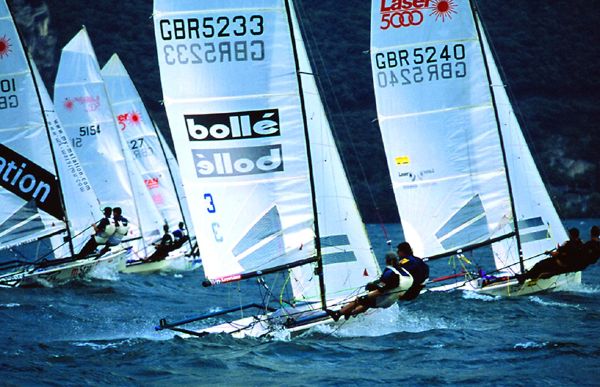
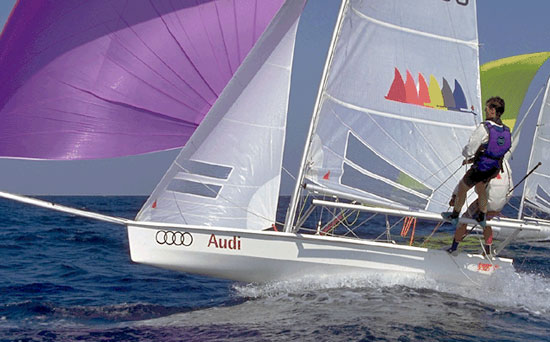 As befits a boat from the Laser stable, the 5000 is essentially a simple craft with few frills or complications. Fast, fun and above all exciting, the 5000 is clearly the kind of boat we ought to be sailing in the 21st century.
Fast and furious though the 5000 is, it clearly does not have the aspirations to be the ultimate speed machine. Durability, cost and one-design status have been put before pure speed and, it must be said, the boat is none the worse for that. The hull lines drawn by Phil Morrison are moderate in every respect; static stability is more than adequate with no descernible shortcomings at speed.
Construction follows the well established Laser philosophy of using a mixture of woven and chopped glass reinforcement materials in a solid laminate of polyester resin. The deck is similarly constructed, with the addition of a foam sandwich core. Though heavier than an all-sandwich boat, the 5000 scores on durability and our pre-production prototype test boat, the victim of many weeks hard sailing, looked very much like new. All the major components are from well established suppliers with Laser themselves building and fitting-out the hull, Proctor supplying the rig and Hyde the sails. Our test boat appeared well put together and maintenance should be simple and limited in quantity.
Fittings are from a variety of sources, all of them top quality and, apart from the rudder assembly, no fault could be found. Sadly, the lower rudder fitting on our test boat failed while we were sailing. The rudder stock itself was a non-production item, but the parts that failed, the bolts securing the lower gudgeon, were all standard. The problem will undoubtedly be resolved by the time you read this. The mast and boom are essentially round tubes, though the mast has sprouted a one-piece extruded (rather than riveted-on) luff-track. Support is by means of upper and lower shrouds with the top section also benefiting from a set of adjustable Morrison wires (diamond shrouds). It all seemed very strong and secure.
The sails have clearly been the subject of an enormous amount of development work and were impossible to fault on our test boat. The mainsail is constructed from a relatively heavy Dacron/Mylar material and with five full length battens should last indefinitely. Reinforced material has been used for the substantially sized mainsail and it certainly looks strong enough to content with a crewman in high-diving mode. The jib is made from 5.5-ounce Dacron; and although the loads are undoubtedly high, judicious use of the roller-furler to prevent flogging should maximize the time between replacements. A similar theme is pursued with the spinnaker which is built using Polyand Elastic, a material renowned for its long life, high performance and ease of handling. Foils, like the hull, are from Laser's own factory and are constructed in female moulds.
Aside from the rig and foils, all the major components can be transported in a fully assembled state, keeping the time taken to get from the trailer to the water at a minimum. Stepping the tall mast is facilitated by pinning the heel fitting to the step with the mast lying horizontally out over the stern, attaching the shrouds and jib and pulling up on the spinnaker halyard. The jib furls easily on a Harken roller unit and rig tension can be adjusted using a difficult to work purchase on the front of the mast. Easy enough on shore; not so easy afloat.
Other controls that fall into the nearly non-adjustable category include the outhaul — mounted under the boom, and the daggerboard — buried under the spinnaker bag. Given the high apparent wind speeds and wide angles sailed downwind, neither of these is likely to present a problem.
Upwind in a straight line, the boat is relatively easy to sail. Difficult though it appears, getting out onto the racks — and back again — is no problem for sailors of average height. We were left wondering how shorter crews (with longer racks) would manage, though in practice, increased agility would probably prove adequate compensation for shorter legs. Communication between the helmsman and crew is on a more equal footing than is the case in a single trapeze boats and team work is the key to performance. A well balanced rudder provides fingertip control while the principle mainsail controls, sheet, Cunningham and kicking strap all fall easily to hand. Though lacking a ratchet block, the 2:1 jib sheet proved easily adjustable if highly loaded. This area of the boat does, however, require good housekeeping if the cleat is not to become the center of a bird's nest.
With a vast sail plan, the Laser 500 is a performer is light winds, achieving full upwind planing just five or six knots of breeze. As the wind increases things become even more interesting, though never on our test (in up to 22 knots) out of control. Combined use of kicking strap and Cunningham renders the rig superbly controllable with additional adjustment available before departure in the form of Stay-lok adjusters on the lower shrouds.
As with most high-performance boats it's turning the corners that presents most of the problems. The 5000 is not a difficult boat to tack, but it does require confidence and coordination from both crewmen. The trick seems to be, as you might expect, to start the tack reasonably fast and exit more gently. Once the boat slows, control is reduced and the problems begin.
In much the same way, downwind sailing in itself is not a difficult art to master. Getting stopped and started can, however, prove troublesome especially if the spinnaker is allowed into the water. The boat is well engineered to prevent problems of this kind with every control working freely; even the pole outhaul — often a problem in bowsprit boats — runs smoothly. The vast crocodile of a spinnaker bag with its boom-mounted elastic opener takes some getting used to, but once mastered proves highly effective. In any sort of a breeze, hoisting the kite can only be accomplished by bearing away onto a run. Once it's up, all that remains is to get to the windward side and wait for the ride of a lifetime. Acceleration is electric and foot-straps for helmsman and crew are a must. In some respect the boat is intimidating to sail, with a huge rig, massive acceleration, twin trapezes and wide wings. Practice certainly makes things easier, and as Andy Hemmings, himself no stranger to high performance trapeze boats commented, the second sail is a lot easier than the first. Those used to sailing high-performance boats with spinnakers should find the trasition no real problem. Anyone without high-speed trapeze and spinnaker experience thinking of transferring to the class would be well advised to hone their skills in these areas before setting foot in a 5000. Fortunately everything works smoothly, but make no mistake this is not a boat for the weak or feeble.
Performance Equality Among the features on the 5000 original design brief, the need to equalize performance between crews of differing size and stature was one of the most significant. This aim has been achieved in a highly satisfactory manner on the Laser 5000 by incorporating a couple of simple features that make the boat itself adjustable.
Step one is to equalize all-up sailing weight. An area aft of the daggerboard case has been designed to accept specially shaped lead weights. Weights can be added in 1kg increments and it is intended that correctors will be color coded for easy checking. Step two is slightly more complicated. Using a simple calibrated plank (above, left) the vertical centre of gravity height of both crew members is established. Combined with weight, this determines the available righting force. The combined righting moment and weight (Laser call this the Power Factor) is then entered into a set of tables which gives rack settings. The racks are simply extended (above centre and right) to the appropriate length and locked using pins. Every boat is thus endowed with an equal amount of power. Currently the system can cope with combined crew weights of between 130 and 170Kg (two Europe sailors together at one end of the scale — one Finn and one Laser sailor together at the other). Whether two small sailors will be able to compete with two big sailors remains to be seen.
In all probability, strength rather than size will set the lower cut off point for crews. Until such time as compelling evidence is brought forward proving the need for change, the correction for weight and righting moment will be linear. That's to say, for every 1 kilogram of extra crew weight added, 1kg of lead is removed and vice-versa. Similarly righting moment is equalized for all boats.
While the performance equalization formula is clearly not perfect — it cannot take account of the dynamic effects or varying strength levels of different crews — it's nearer to perfection than anything else currently available.
Boat Specifications
| Length | 5.00m | |
| Length with pole | 7.60m | |
| Beam-Hull | 1.84m | |
| Beam-Racks minimum | 1.90m | |
| Beam-Racks maximum | 3.05m | |
| Mast Height | 8.50m | |
| Sail Area - Main | 15.3sq n | |
| Sail Area - Jib | 5.8sq m | |
| Spinnaker | 30sq m | |
| Price | 7895 pounds | |
| Contact | The Laser Centre 6 Riverside Banbury | OX168TL (0295) 273682 |